Building a house in a bunch of short trips

Standard

This blog has been quiet for a while, but not because we haven’t been traveling. It’s just that all our trips have been short jaunts off the island rather than journeys to exotic places like China or Texas.

Ever since Island County finally agreed to let us build our house next to the “wetland,” we have been working with our contractor to make scores of decisions about things like cabinets, lighting and plumbing fixtures, tile, counters, windows and doors, fireplaces, appliances, flooring, and other materials and finishes. Continue reading

Hot music and hot weather at the Kate Wolf Festival

Standard
Some of the festival crowd listening to the Playing for Change Band.

Some of the festival crowd listening to the Playing for Change Band.

We spent four days last week at California’s Kate Wolf Music Festival, where both the music and the weather were hot.

We arrived on Thursday to a huge southbound traffic jam on Highway 101. When we finally reached the festival gates, we were waved on and had to find a spot in the even longer traffic jam heading north. This was the first year the festival opened on Thursday so there were some glitches. Apparently a California Highway Patrolman decided that the festival could not open until the traffic jam cleared, even though the best way to clear the jam was to get people off the highway and into the festival. Broderick Crawford would not have approved. Continue reading

China, day 17: A visit with children and the end of the trip

Standard

When we left the United States, we brought an extra suitcase with us. The suitcase was part of a mission we promised to complete while we were in China.
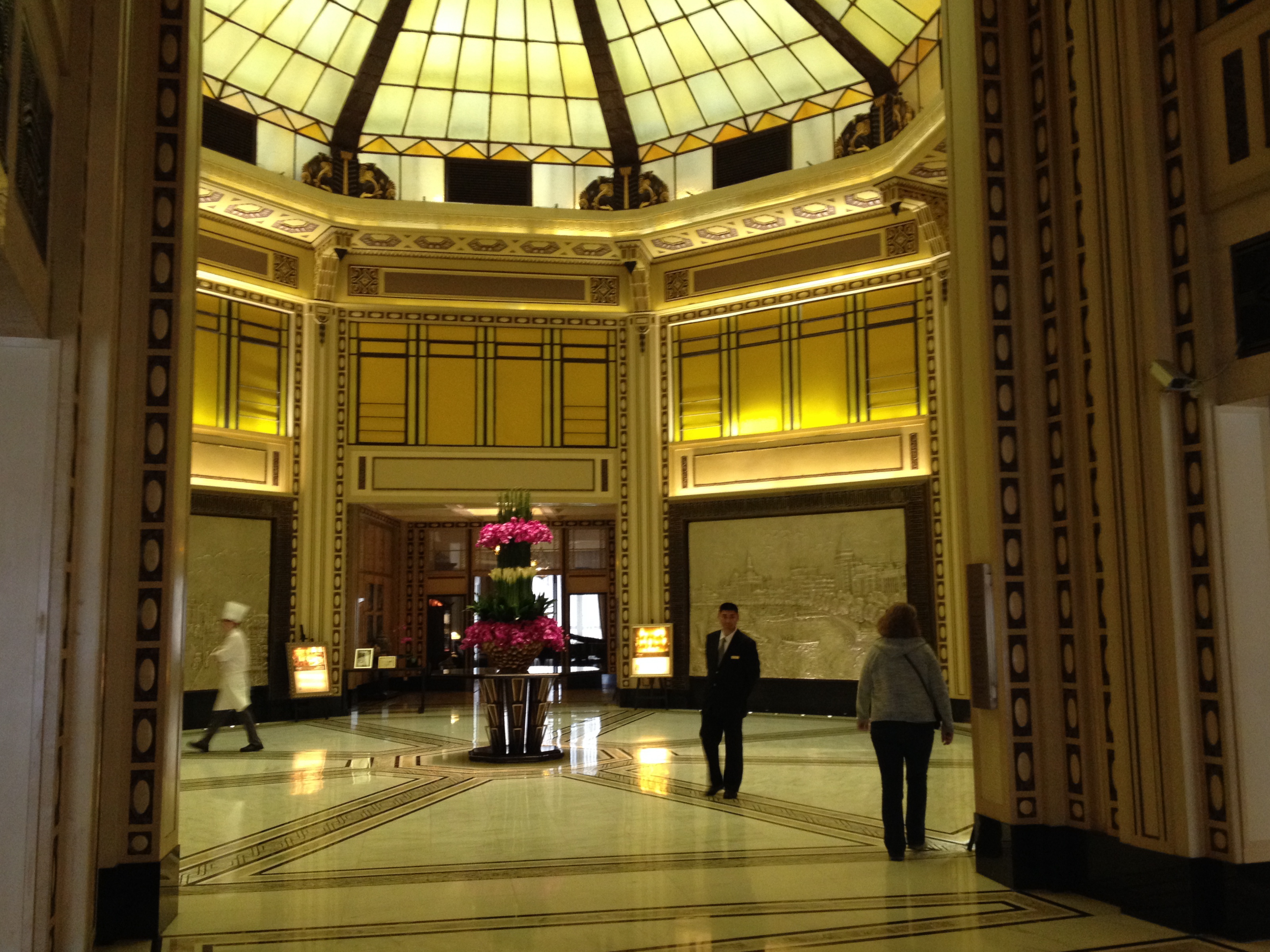
Part of the lobby of the Fairmont Peace Hotel

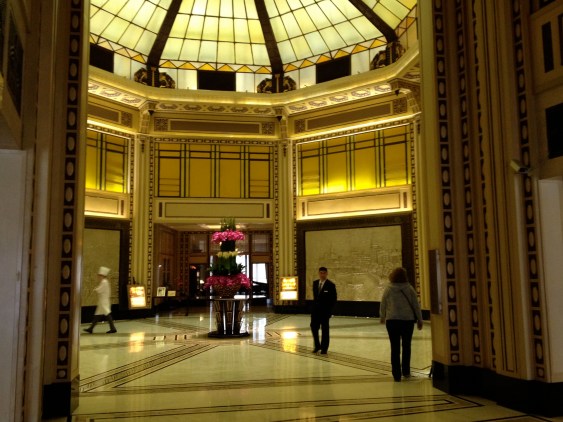
Part of the lobby of the Fairmont Peace Hotel

Before that, a word about our hotel. All the hotels where we stayed in China were five-star and probably nicer than hotels we would have gone to if we had arranged the trip on our own. But our Shanghai Hotel was even more, a tourist destination in and of itself. Now called the Fairmont Peace Hotel, it was built in 1929 as the Cathay Hotel by Victor Sassoon, a wealthy British businessman who owned much of Shanghai. The Cathay, Shanghai’s elite hotel in the 1930s, was renamed the Peace Hotel by Mao’s government in 1959. It was refurbished and reopened by Fairmont in 2010 and retains much of its art deco charm.
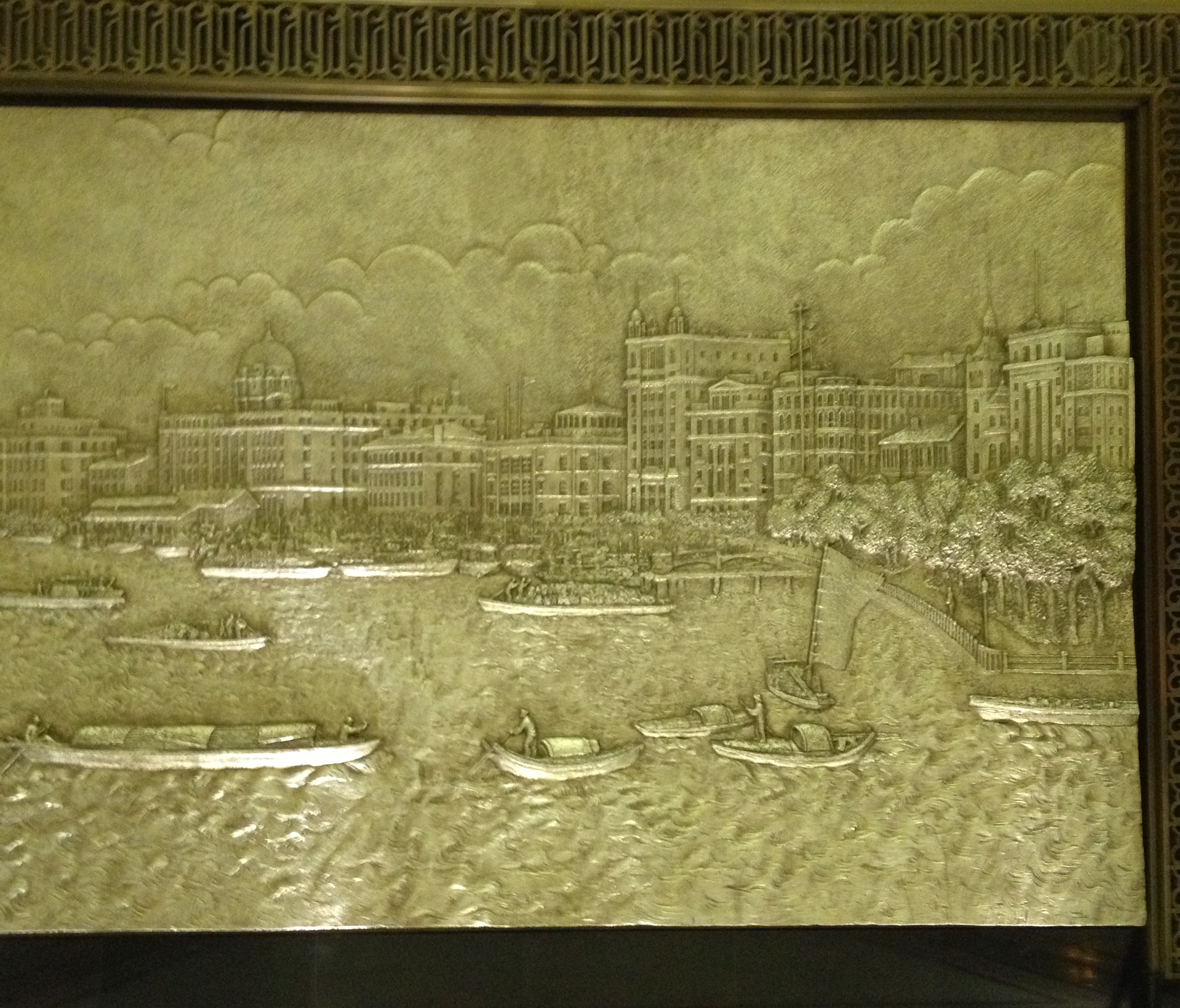
One of four reliefs on the hotel lobby walls

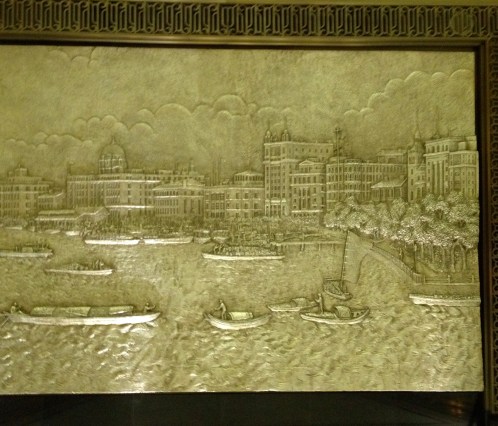
One of four reliefs on the hotel lobby walls

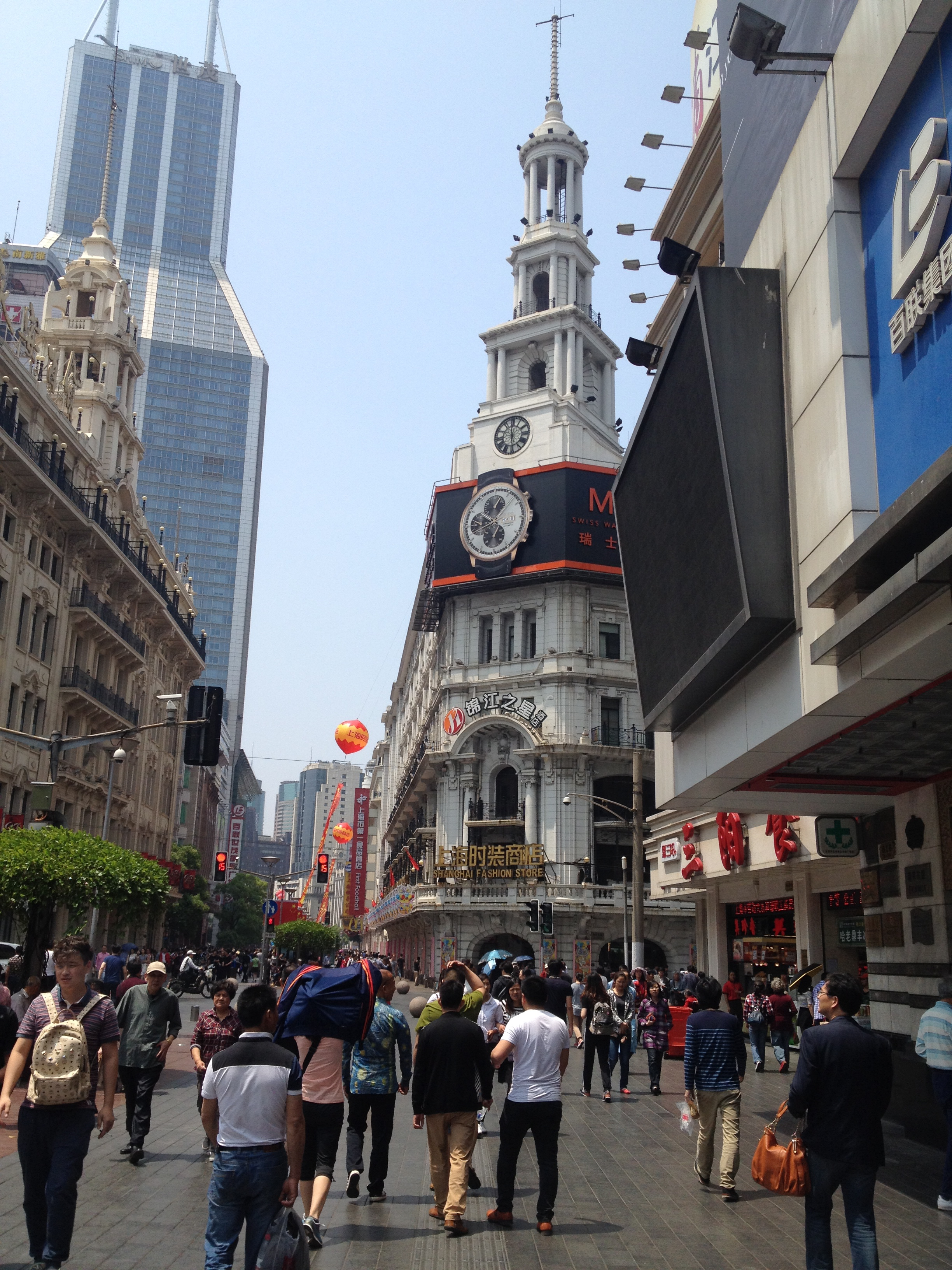
Many of our group went with Matthew today to ride the Maglev Train and see some more Shanghai sights, but we skipped that. We did take a walk down Nanjing Road, Shanghai’s iconic street that runs in front of the total. It’s quite a busy shopping street and was extremely crowded.

Then we grabbed our extra suitcase and set out on our mission. The hotel concierge got us a taxi, and Matthew had written out the address in Chinese. It was about a half-hour trip farther out into Puxi, near the old Shanghai airport.

Our destination was a house in a development called Long Beach Garden Villa. It is the home of Shining Star, a residence for blind and partially sighted orphans. It is connected to another charity called One Less Orphan or the Children’s Garden that was started by a woman named Naomi Kerwin, who is an old schoolmate of our friend Kristin Goss.
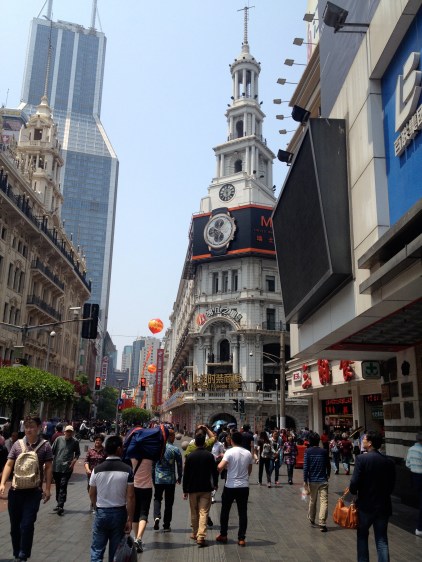
The Nanjing Road, awash with shoppers

The Nanjing Road, awash with shoppers

Naomi was in Australia for a wedding, so we met with Julie Garratt, who runs Shining Star. Julie hails from Great Britain and came to China as a trailing spouse with her husband, an automotive engineer. To her we delivered the items we had brought, as requested by Naomi: disposal diapers for infants, powdered baby formula, child-sized collapsible white canes, extra tips for the canes, and raffle tickets. (Gambling is illegal in China, so raffle tickets are not to be had.)

The baby formula aroused the curiosity of a customs official in Vancouver when we were flying over. “Where’s the baby?” he asked. Replied Robin: “In China.” I wondered if we would be questioned when we went through Chinese customs, but no one was even at the customs desks in Beijing, so we just walked through.

We got to meet the children and discovered that they spoke very good English. One six-year-old girl boldly asked us our names but declined to provide her own. She was the only girl, but she seemed to be in charge, ordering the little boys about. When I told 10-year-old Thomas his English was excellent, he said, “Of course it is. I’m going live in England soon.” Shining Star places its children in adoptive homes, mostly abroad. The precocious six-year-old was headed for America. Tom, who was born without eyes, had outgrown his old cane and was excited that we had brought him a new one.

We arrived just as the children were waking up from their afternoon naps. One little boy, called Cho-Cho, woke up crying, and Robin held him for a long time until he became calm. In addition to being blind as the result of an eye infection that went untreated, he has muscular dystrophy, which makes his prospects for adoption dim.

At the end of our visit, Julie arranged for an Uber car to take us back to our hotel. The car was much newer and nicer than the taxi that had brought us, and the driver, unlike the taxi driver, spoke English. He worked as a financial consultant for automotive companies, which is how he could afford to have a car in Shanghai. He was very interested in One Less Orphan and said he would tell his friends about it.

Back at the hotel, we asked the concierge for a restaurant recommendation and he sent us to a place just down the Bund. As we walked to the restaurant, the streets were lined with soldiers, the largest military presence we had seen since Tibet. I wondered if there was some visiting dignitary but later learned that the troops were there for crowd control, it being the eve of Mayday. Last New Year’s Eve, 36 people died when a crowd on the Bund stampeded, so now the government takes extra precautions.

The restaurant was called Hakkasan, which turned out to a branch of a London restaurant. We dined very well throughout our stay in China, but this might have been the best meal we had, including vegetarian dim sum, Sichuan sea bass, and Jasmine-tea-smoked chicken.

The following morning we flew home.
China, Day 16: The gardens, canals, and silk of Suzhou

Standard

Wednesday, April 29

Today, with 16 of the 18 people who stayed on for the “Shanghai Extension,” we made a trip to Suzhou, a nearby city that is sometimes called “the Venice of China.”

Fish pattern set into a path

Cricket pattern set into a path

Suzhou (pronounced sue-joe) is often referred to “little Suzhou”  next to giant Shanghai, but it is in fact a city of more than 10 million people. It has recently become a major high-tech center, but it is more famous for its gardens, its silk, its canals (hence the nickname), and its “beautiful ladies,” according to our local tour guide, a sprightly young woman named Allie.

Souzhou has some connections to the Pacific Northwest. One of its sister cities is Portland. (Another is Venice, as you might expect.) We also passed something called the Fall in Love With Seattle Bar, apparently because the movie “Sleepless in Seattle” was one of the few American movies allowed in China in the 90s. Continue reading

China, day 15: Shanghai Museum, garden, and acrobats

Standard

Tuesday, April 28

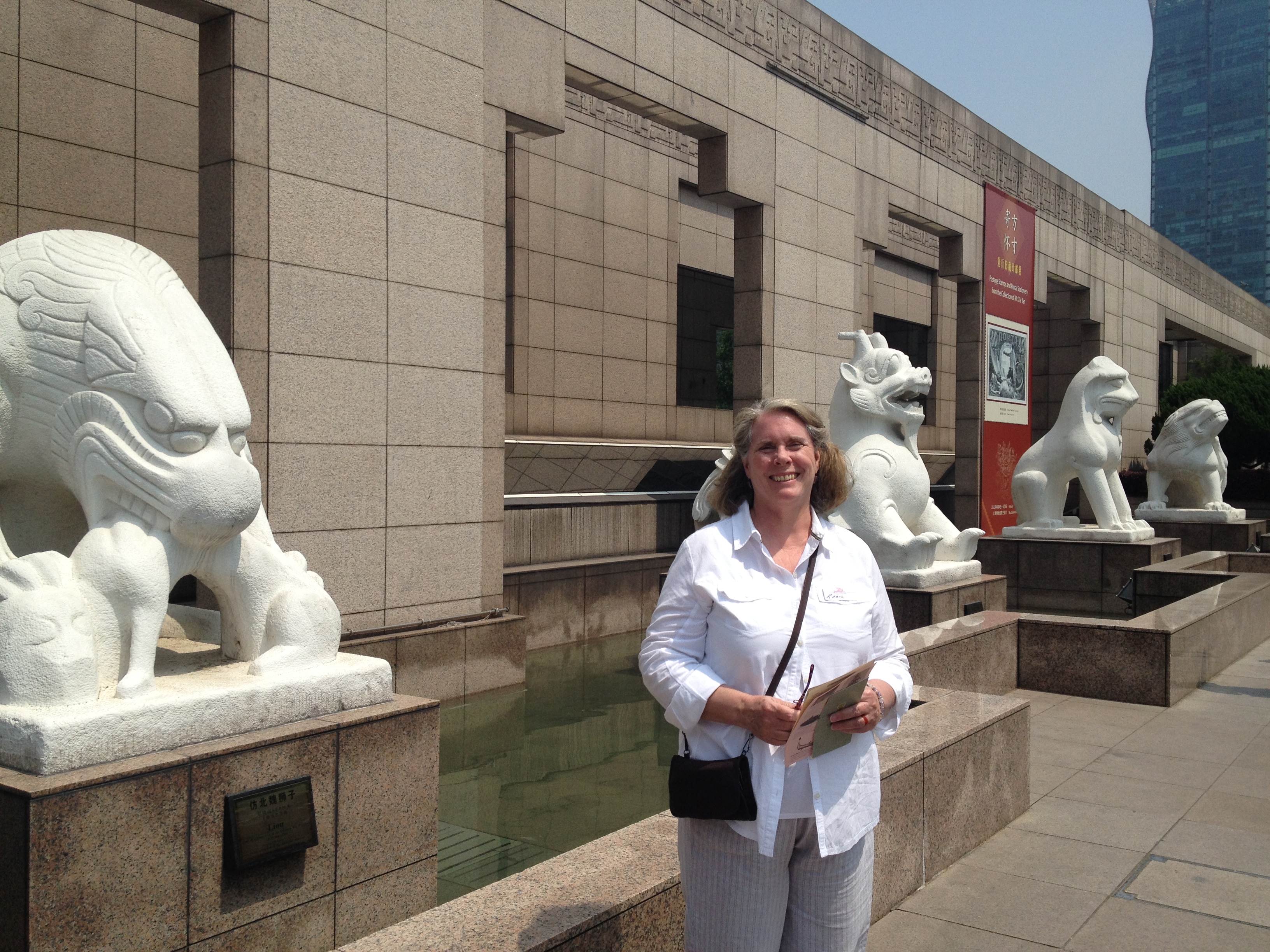
Robin outside the Shanghai Museum

Robin outside the Shanghai Museum

We began today with a visit to the Shanghai Museum. It is one of the best museums we have been to. It has galleries devoted to bronze, ceramics, calligraphy, painting, sculpture, jade, ivory, currency, bamboo, wood, lacquer ware, and more. We saw only about a quarter of it.

We visited galleries devoted to furniture, painting, and minority arts and crafts. Then Robin went to the jade gallery and I checked out currency. It proved to be case after case of round coins with square holes in the middle that allowed the coins to be strung together for ease of carrying. Most interesting was the earliest money, which was rather large and shaped like axes and other tools — hard to carry around in one’s pocket. Continue reading

China, Day 14: The bells of Wuhan and the lights of Shanghai

Standard

Monday, April 27

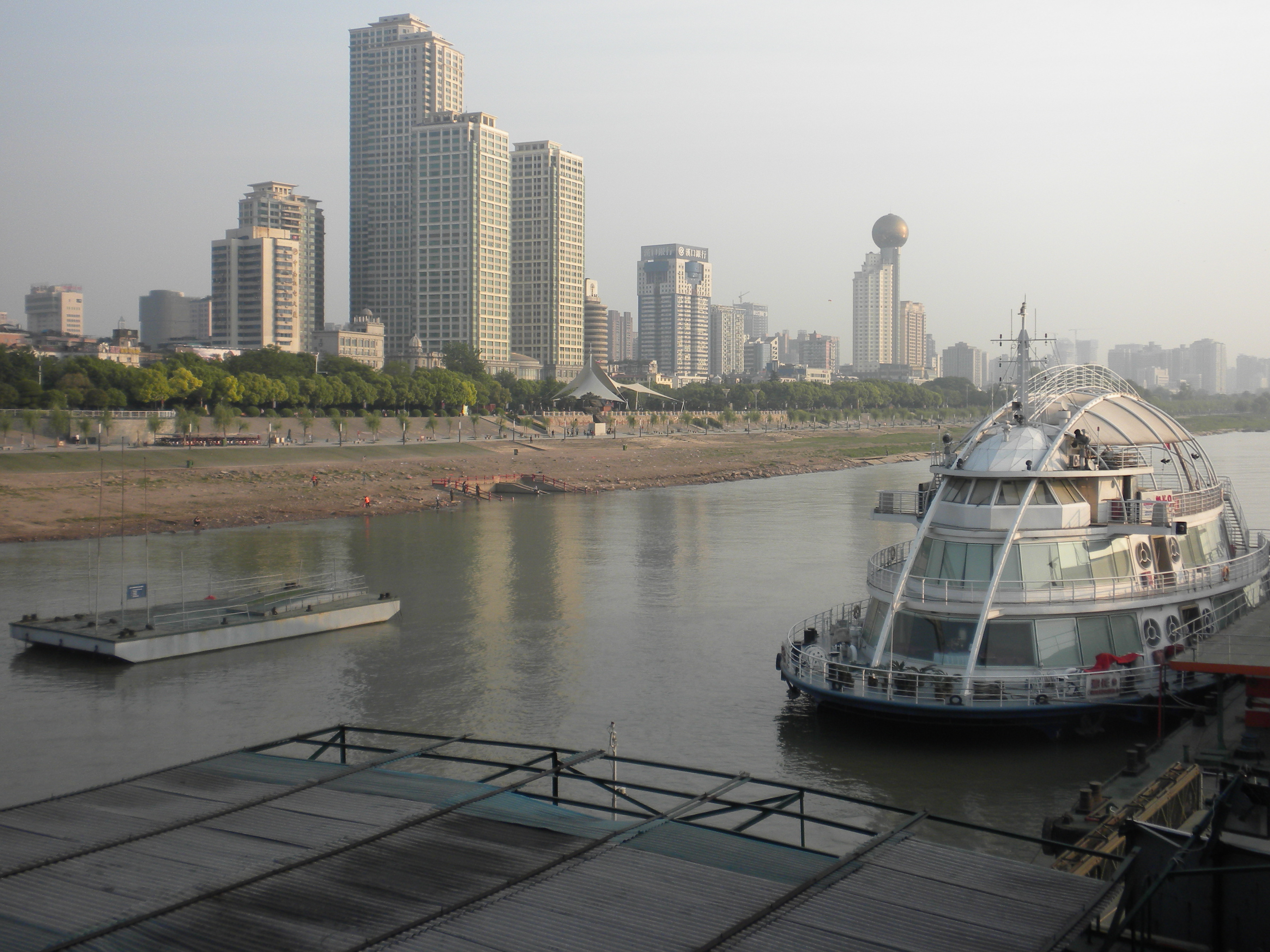
Wuhan, with an unusual boat in the foreground

Wuhan, with an unusual boat in the foreground

This morning we arrived in Wuhan, capital of Hubei Province, and said farewell to the Viking Emerald. Before boarding our flight to Shanghai, we visited the Hubei Provincial Museum, one of the best-known museums in China.

The museum is perhaps most famous for its collection of ancient musical instruments, many of them unearthed from the tomb of a worthy called the Marquis Yi of Zeng, a fifth-century nobleman. In addition to viewing the bells and other instruments on display, we were treated to a performance, on replicas, of Chinese music and of Beethoven’s “Ode to Joy”: Continue reading

China, day 13: Visit to a school

Standard
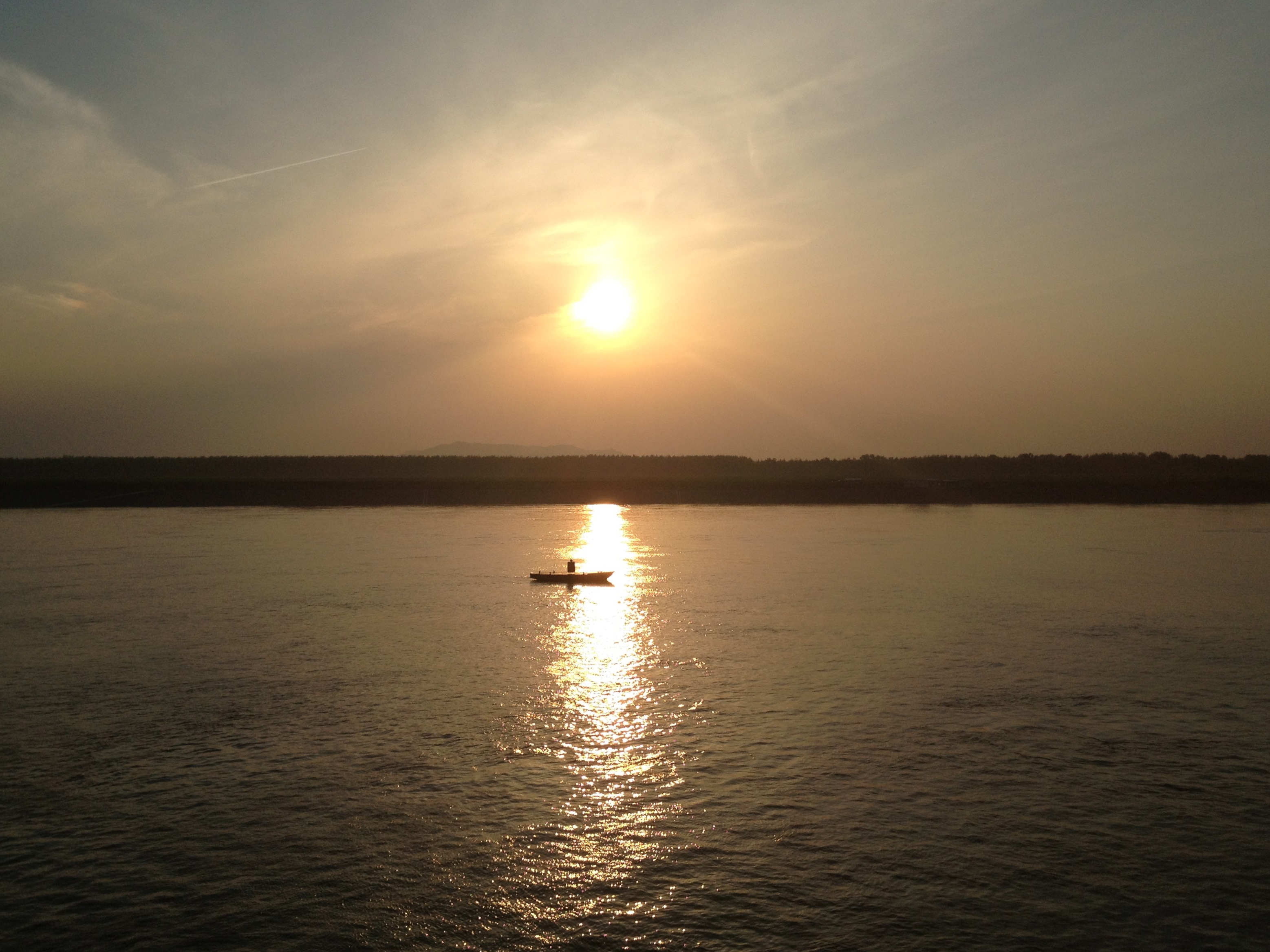
Sunset on the Yangtze

Sunset on the Yangtze

Sunday, April 26

After passing through the dams, the river is much lower and the surrounding countryside is much flatter, producing some beautiful effects as the sun drops toward the horizon.

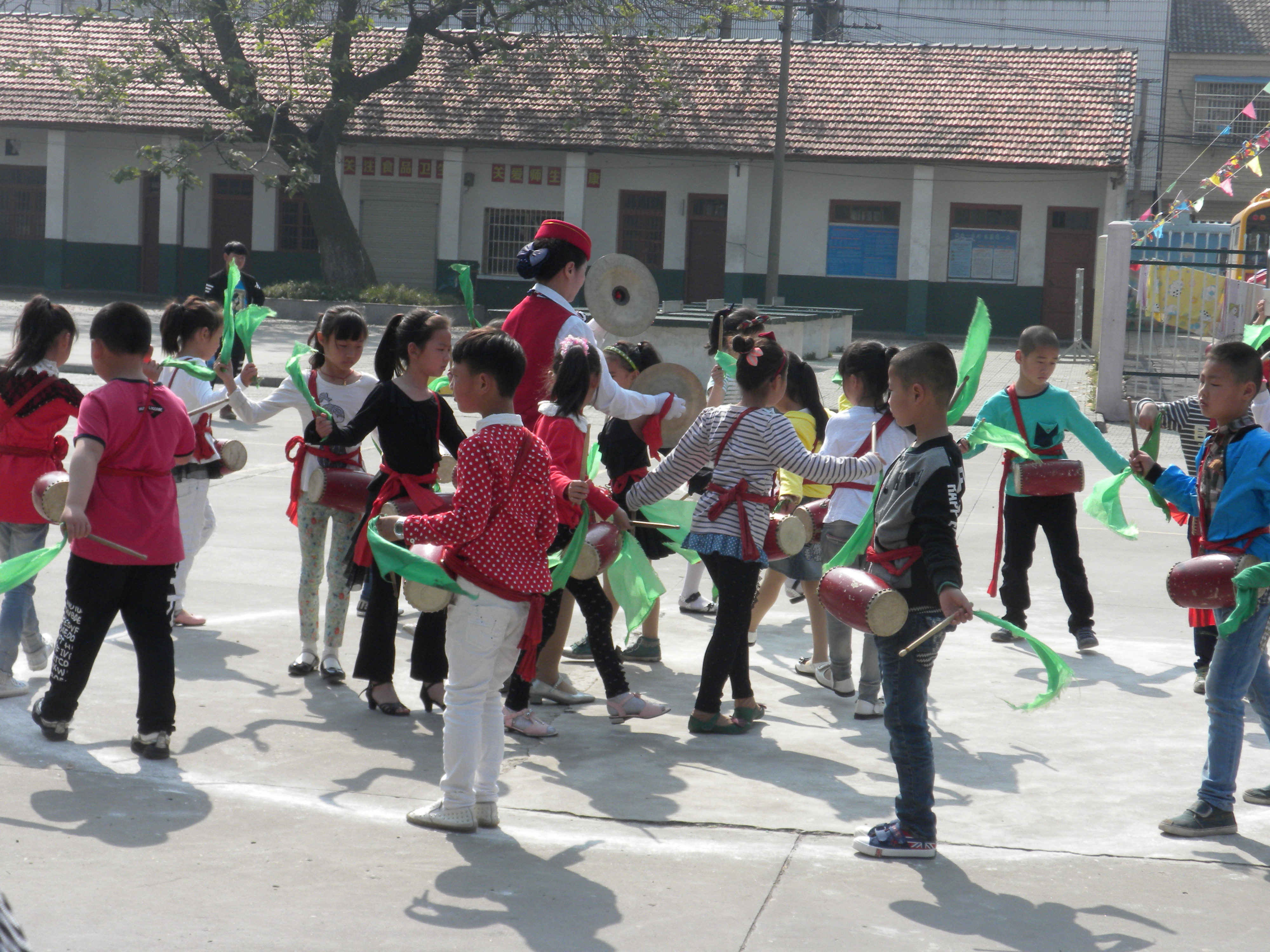
School children performing

Schoolchildren performing

We stopped in Jingzhou, a small city by Chinese standards (about a million people). Here we visited a public school, one of three that Viking supports in China. Viking has provided equipment like computers and projectors and a new running track. But the school still seems hard-pressed. The desks are old and beat up, and the average glass size is 53.

Even so, the school seemed like an oasis in the middle of largely commercial and somewhat grubby area. The students welcomed us with drums and then some dance and martial arts performances. After that, our group went to a fifth-grade classroom. Each of us was escorted in by a student and led to a desk. My escort knew the back way in and got us quickly seated but didn’t seem to know any a English, so I had trouble making contact. Robin’s escort was charming, seemed to understand what Robin said, and was fluent in counting in English. Continue reading

China, day 12: The Three Gorges Dam

Standard

Saturday, April 25

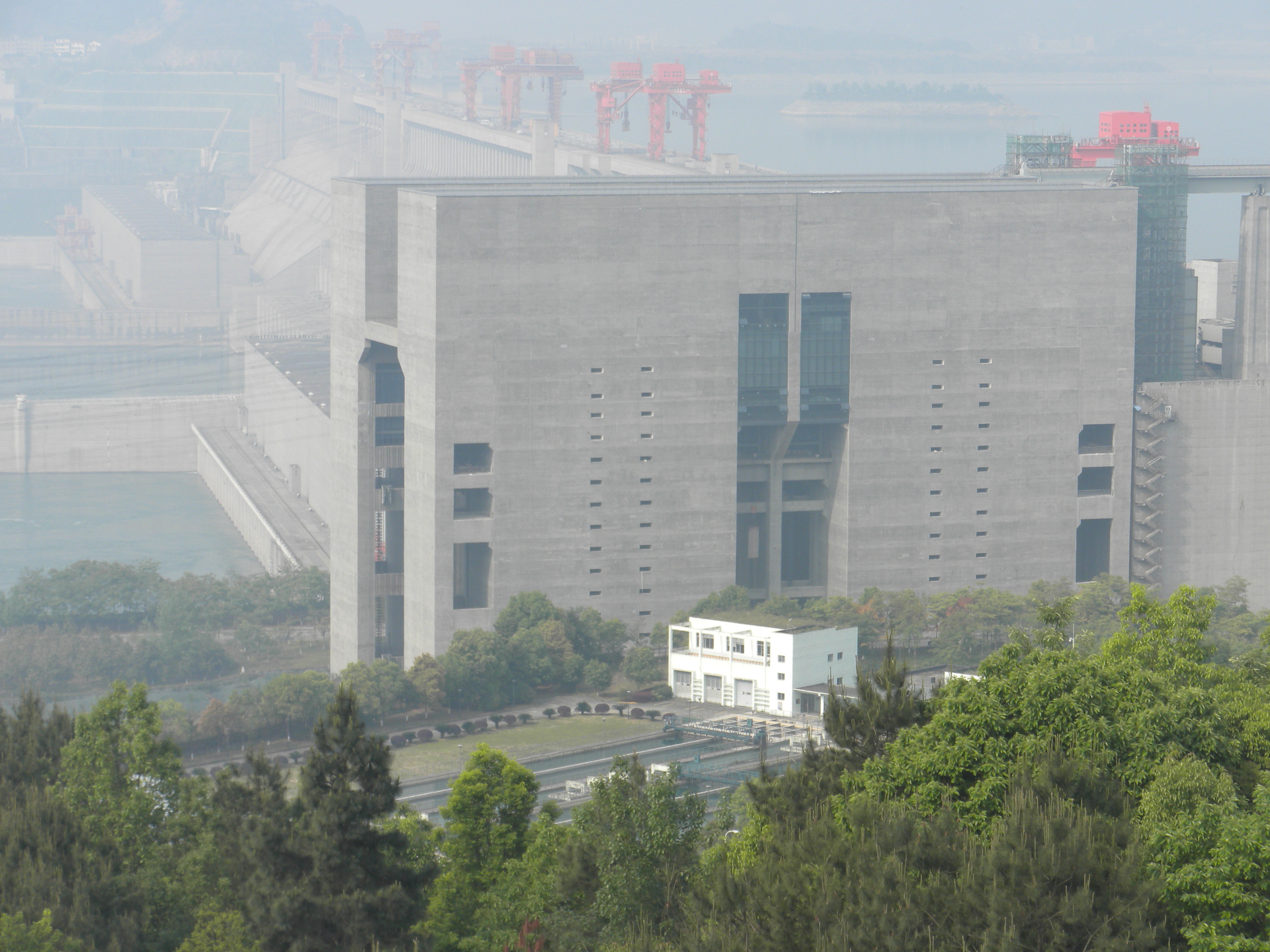
The ship elevator, with the dam in the background

The ship elevator, with the dam in the background

China is like Texas in one way: Everything here is big. One of the best examples of that is the Three Gorges Dam, which we toured today.

The dam is the largest hydroelectric facility in the world and holds more than 100 world records. It used 35 million cubic yards of concrete and 463,000 tons of steel (equal to 63 Eiffel Towers) and required moving about  134 million cubic yards of earth. It is 7,661 feet long and 594 feet high. With its 32 main generators (weighing 6,613 tons each) and two smaller ones running, it generates enough electricity to light four Las Vegases for a year. The reservoir created by the dam is twice as big as the Great Salt Lake. And so on. Continue reading

China, day 11: The Lesser Three Gorges and the locks

Standard
Viewing Qutang Gorge from the top of the ship

Viewing Qutang Gorge from the top of the ship

Friday, April 24

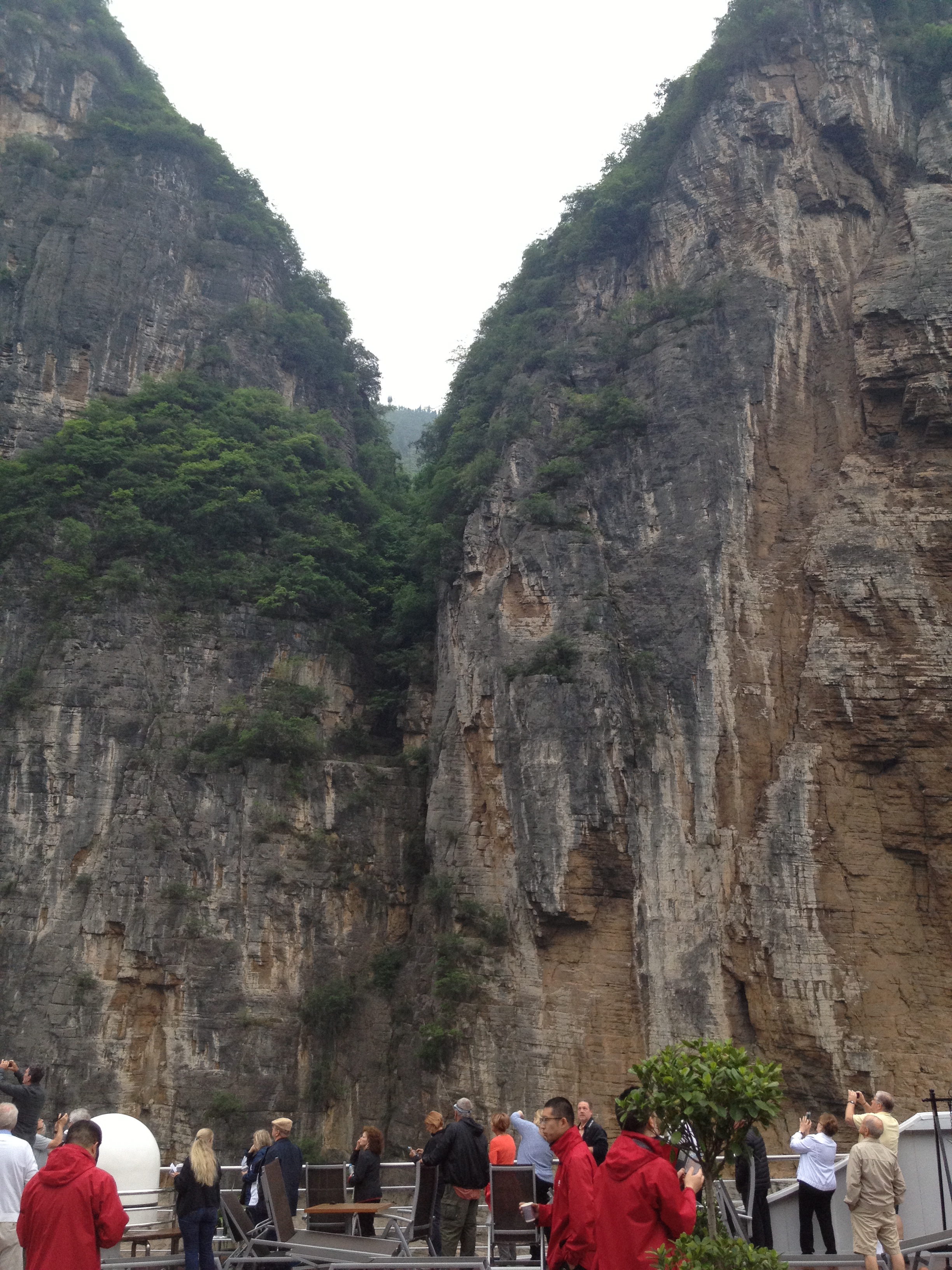
We got up early to view our passage through Qutang Gorge, the first of the Three Gorges. We went up to the sun deck, which retains that name even when it is not sunny, as it was not this morning.

As we entered the gorge, we had a brief introduction from the boat’s river guide, Ben. Qutang is the shortest of the gorges but it us also regarded as the most picturesque. The gorge was beautiful, though it was a bit misty as we passed through, so we perhaps we did not get the full impact.

It only took about half an hour to pass through the gorge. Then we went down to breakfast.

At 9:45, the ship came to a stop at the entrance to the Goddess Stream, so called because of a rock formation called the Goddess, which is barely visible from the river. Continue reading

China, day 10: Cruising the Yangtze and a visit to the Shibaozhai Pagoda

Standard
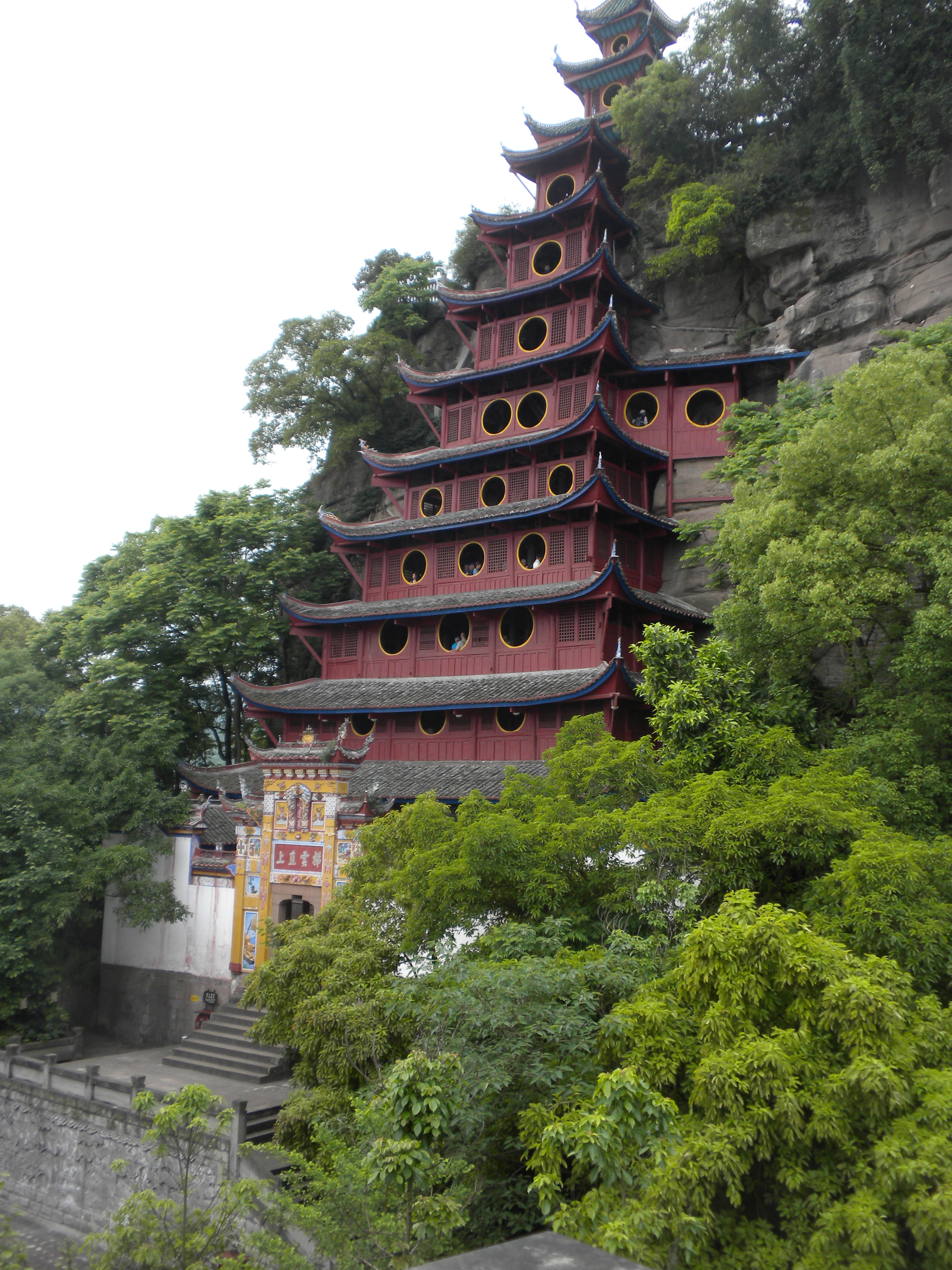
The Shibaozhai pagoda

The Shibaozhai pagoda

Thursday, April 23

The pace of life on the ship is much slower than it was on land. Instead of three or four activities per day, we have one excursion. Today’s was a stop at the town of Shibaozhai, which boasts an extraordinary pagoda that is built into the side of a cliff.

Shibaozhai is one of many towns along the Yangtze that was relocated because of the Three Gorges Dam. We walked through the town on our way to the pagoda. Although the route to the pagoda was lined with stalls full of merchandise aimed at the many tourists, both Chinese and Western, who come here, the rest of the town seemed pretty dead. (There is a second part of the town, across a tributary of the Yangtze, that is more industrial.) Continue reading